



在一万米深海,每平方厘米承受的压力接近一吨。
这里没有阳光,海水接近冰点,压力超过100兆帕。一个微小裂纹、一处密封偏差,都可能在巨大水压下被迅速放大。
2026年6月,我国首套万米级全海深电磁采集站完成海试验收,并在西太平洋7737米水深获得有效数据。深海探索正在从“能不能下去”,走向长期观测和工程作业。
当装备需要长期、反复作业,耐压结构面对的就不再是一次极限挑战,而是强度、重量、腐蚀和寿命的综合考验。
支撑这些装备进入深海的重要材料之一,正是钛合金。
At a depth of 10,000 meters below the ocean surface, every square centimeter is subjected to nearly one ton of pressure.
There is no sunlight here. Seawater temperatures are close to freezing, while pressure exceeds 100 MPa. A tiny crack or even a slight deviation in a seal can be rapidly magnified under enormous hydrostatic pressure.
In June 2026, China’s first full-ocean-depth electromagnetic acquisition station designed for depths of up to 10,000 meters completed its sea trials and acceptance testing, successfully acquiring data at a depth of 7,737 meters in the western Pacific. Deep-sea exploration is moving beyond simply asking whether equipment can reach the depths toward long-term observation and engineering operations.
As equipment is required to operate repeatedly and for extended periods, pressure-resistant structures face more than a single extreme challenge. They must balance strength, weight, corrosion resistance, and service life.
One of the key materials supporting these capabilities is titanium alloy.
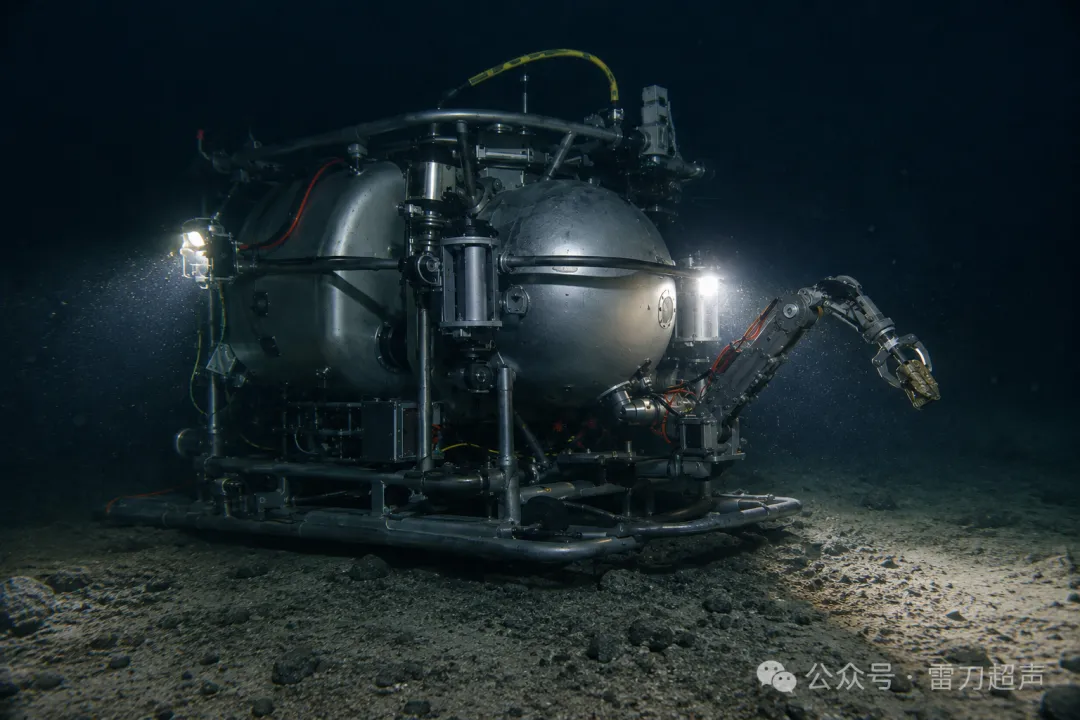
万米水压考验的,不只是强度
深海装备承受的是海水从四面八方施加的外压。结构未必先被“压碎”,也可能因为局部变形发生失稳。一次下潜能够承压只是第一关,反复下潜和上浮,还会带来循环载荷与疲劳风险。
因此,耐压结构需要的不只是高强度,还要兼顾重量、韧性、耐腐蚀和长期可靠性。
钛合金的密度约为钢的六成,却具有较高的比强度;表面形成的致密氧化膜,又能抵抗海水腐蚀。减轻耐压结构的重量,也能为机械手、探测仪器和采样系统留出更多载荷空间。
2020年,“奋斗者”号完成10909米载人深潜,其三人载人球舱采用我国自主研制的Ti62A钛合金。研发过程解决的不只是材料强度问题,还包括大规格厚板均匀性、成形与焊接等制造难题。
钛合金成为深海装备的“骨架”,靠的不是某一个性能数字,而是一组综合能力。
Withstanding 10,000 Meters of Water Pressure Takes More Than Strength
Deep-sea equipment is subjected to external hydrostatic pressure from seawater in all directions. A structure does not necessarily fail by being simply “crushed.” It can also become unstable as a result of localized deformation.
Surviving the pressure of a single dive is only the first test. Repeated descent and ascent introduce cyclic loading and fatigue risks.
Pressure-resistant structures therefore need more than high strength. They must also balance weight, toughness, corrosion resistance, and long-term reliability.
Titanium alloys have a density of roughly 60% that of steel while offering high specific strength. Their naturally formed, dense oxide layer also provides excellent resistance to seawater corrosion.
Reducing the weight of pressure-resistant structures leaves more payload capacity for robotic manipulators, sensing instruments, sampling systems, and other mission equipment.
In 2020, the Fendouzhe submersible completed a crewed dive to 10,909 meters. Its three-person crewed pressure sphere was manufactured using Ti62A titanium alloy, independently developed in China.
The development challenge involved far more than material strength. It also required solving manufacturing issues such as uniformity in large-format thick plates, forming, and welding.
Titanium alloys have become the “skeleton” of deep-sea equipment not because of a single performance metric, but because of their combination of properties.
材料合格,不等于零件能够下海
一块性能合格的钛合金,距离可靠的深海部件仍有很长的制造链。
从材料成形、焊接,到精密加工、无损检测和压力试验,每一道工序都在决定材料性能最终能够保留多少。耐压壳体上的连接孔、观察窗接口、密封面、法兰和传感器安装位,都需要精密加工。
这些结构看似只是局部细节,却是应力容易集中的位置。加工偏差不仅影响装配,还可能改变载荷传递路径;表面缺陷也可能在反复承压过程中逐渐扩展。
钛合金导热性较低,切削热容易集中在刀具附近;高温下又容易与刀具发生黏附,加快刃口磨损。刀具状态发生变化后,尺寸、毛刺和表面质量也会随之波动。
对于普通零件,一道刀纹可能只影响外观;对于承受高压循环的部件,孔口毛刺、表层损伤、残余应力或圆度偏差,都可能成为后续失效的起点。
因此,深海钛合金加工不能只看尺寸是否达标,还要关注表面完整性,以及加工过程有没有消耗设计留下的安全余量。
A Qualified Material Does Not Automatically Make a Sea-Ready Component
A titanium alloy with qualified material properties still has a long manufacturing journey ahead before it becomes a reliable deep-sea component.
From material forming and welding to precision machining, nondestructive testing, and pressure testing, every process determines how much of the material's original performance can ultimately be retained.
Pressure-resistant structures contain many precision-machined features, including connection holes, viewport interfaces, sealing surfaces, flanges, and sensor mounting points.
These may appear to be small details, but they are also areas where stress can become concentrated.
Machining deviations can affect not only assembly, but also the way loads are transferred through the structure. Surface defects may likewise become sites for progressive damage under repeated pressure cycles.
Titanium alloys have relatively low thermal conductivity, making it difficult for cutting heat to dissipate quickly. At elevated temperatures, titanium also tends to adhere to cutting tools, accelerating tool-edge wear.
As tool conditions change, dimensional accuracy, burr formation, and surface quality can fluctuate accordingly.
For an ordinary component, a tool mark may be little more than a cosmetic issue. For a component subjected to repeated high-pressure cycles, however, burrs around holes, surface damage, residual stress, or deviations in roundness can all become potential starting points for subsequent failure.
Deep-sea titanium alloy machining therefore cannot focus solely on whether dimensions meet specifications. It must also consider surface integrity and whether the machining process has consumed any of the safety margin built into the design.
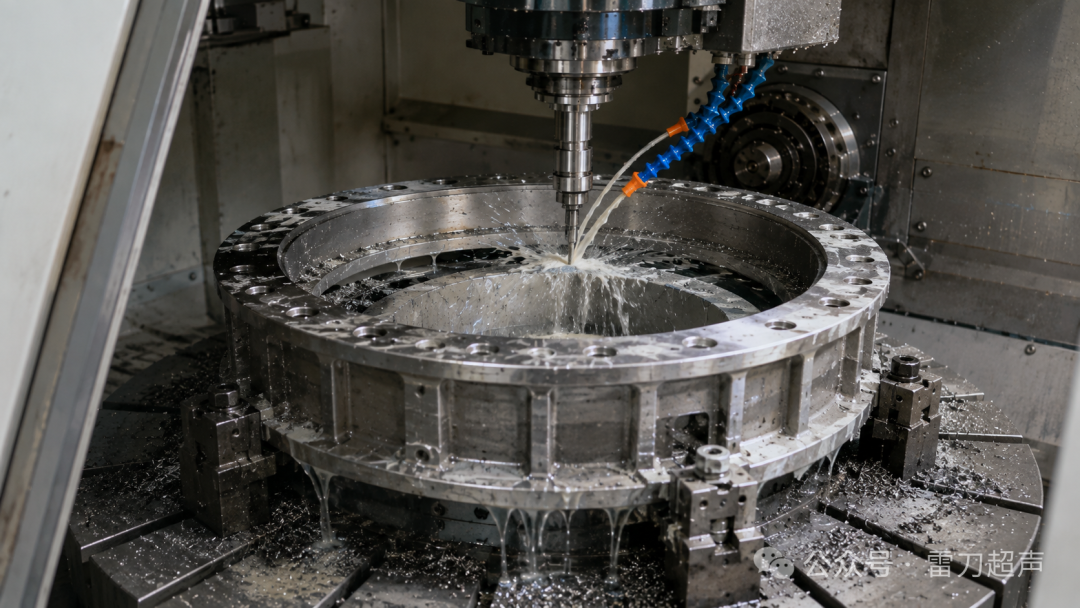
从多次打样,到可验证的钛合金加工
超声加工通过在刀具运动中叠加高频微幅振动,改变刀具与材料持续接触的状态。在参数匹配合理时,有助于减轻持续挤压与黏附,改善排屑和刀具工况,为控制切削负载、毛刺、刀具磨损和表面质量提供新的手段。
对雷刀超声而言,钛合金加工并不是停留在理论上的设想。通过多次钛合金打样,雷刀已围绕不同结构与工况,验证超声状态与刀具、转速、进给、切深之间的匹配关系,并通过加工时间、刀具状态、尺寸精度和最终表面评价结果。
打样的价值不只是展示成品,更是将加工转化为可比较的工艺数据。只有明确参数与切削状态、刀具消耗和表面结果之间的关系,超声能力才能进入更加可复制的加工过程。
这些经验与深海制造的连接点,不是给深海装备简单贴上“超声加工”的标签,而是让数字超声真正参与钻孔、铣削和复杂结构加工,减少刀具磨损、切削波动与表面损伤带来的不确定性。
深海装备的安全余量来自设计,却要靠每一道制造工序保留下来。
钛合金决定装备能否承受万米水压,制造能力决定材料性能最终能够兑现多少。越接近深海极限,加工留下的每一道痕迹,就越不能被当作普通的表面问题。
材料决定它能否下潜,制造决定它能否平安归来。
(欢迎带料试切,眼见为实)
From Repeated Prototyping to Validated Titanium Alloy Machining
Ultrasonic machining superimposes high-frequency, low-amplitude vibration onto the tool's motion, changing the conditions of continuous tool-material contact.
When the process parameters are properly matched, ultrasonic vibration can help reduce continuous compression and adhesion, improve chip evacuation and tool conditions, and provide another means of controlling cutting loads, burr formation, tool wear, and surface quality.
For LEI USM, titanium alloy machining is not merely a theoretical concept.
Through repeated titanium alloy trials, LEI USM has investigated the relationship between ultrasonic vibration conditions and the matching of tooling, spindle speed, feed rate, and depth of cut under different part geometries and operating conditions, evaluating the results through machining time, tool condition, dimensional accuracy, and final surface quality.
The value of trial machining is not simply to demonstrate a finished part. It is to turn machining into comparable and measurable process data.
Only by establishing the relationships among process parameters, cutting conditions, tool consumption, and surface results can ultrasonic capabilities become part of a more repeatable and reproducible machining process.
This is where these machining capabilities connect with deep-sea manufacturing.
The goal is not simply to put an “ultrasonic machining” label on deep-sea equipment. It is to apply digital ultrasonic technology to drilling, milling, and complex-geometry machining, reducing the uncertainty caused by tool wear, cutting fluctuations, and surface damage.
The safety margin of deep-sea equipment may come from the design, but it ultimately has to be preserved through every manufacturing process.
Titanium alloys determine whether equipment can withstand the pressure at 10,000 meters. Manufacturing capability determines how much of the material's potential performance can actually be realized.
The closer equipment gets to the limits of the deep ocean, the less any machining mark left behind can be dismissed as merely a surface issue.
Materials determine whether it can descend. Manufacturing determines whether it can come back safely.
Bring your material for trial machining. Seeing is believing.
免责声明:本网站所转载的文字、图片与视频资料版权归原创作者所有,如果涉及侵权,请第一时间联系本网删除。

官方微信
《腐蚀与防护网电子期刊》征订启事
- 投稿联系:编辑部
- 电话:010-62316606
- 邮箱:fsfhzy666@163.com
- 腐蚀与防护网官方QQ群:140808415
“海洋金属”——钛合金在舰船的
腐蚀与“海上丝绸之路”